
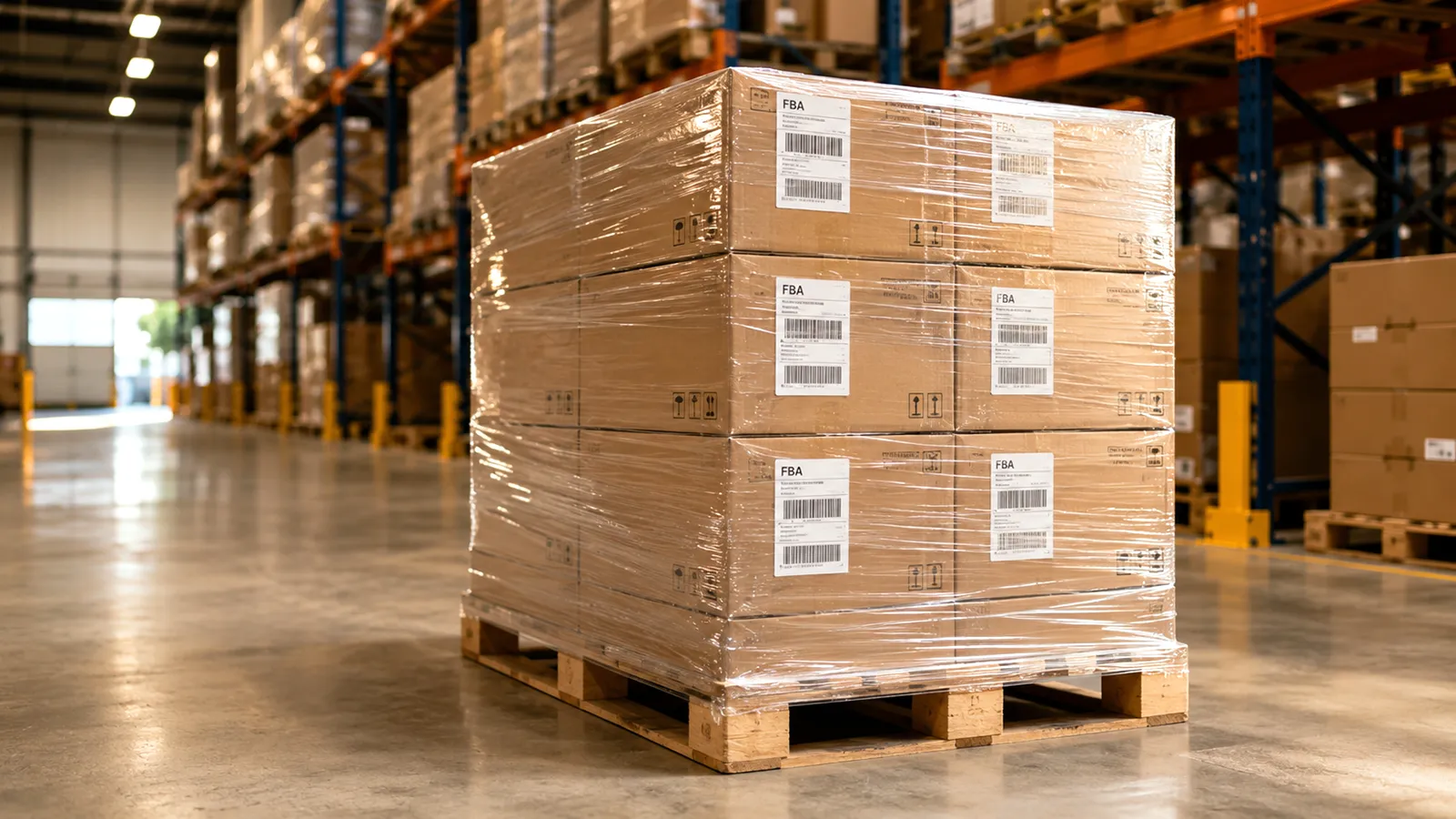

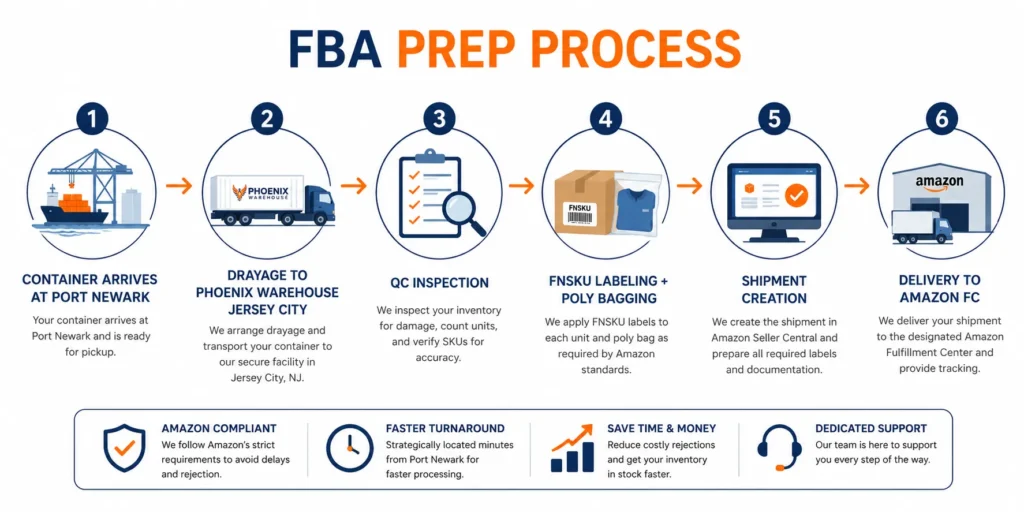
Phoenix Warehouse in Jersey City, NJ is a full-service Amazon FBA prep center, handling FNSKU labeling, poly bagging, bundling, quality control, and shipment creation from our 1,000,000 sq ft facility minutes from Port Newark. For brands importing from overseas or shipping high volumes through Fulfilled by Amazon, a reliable prep center near a major port saves significant time, money, and Amazon rejection headaches.
Amazon’s FBA requirements are strict and unforgiving. Wrong label placement, wrong packaging type, wrong dimensions on a master carton: any of those can get your shipment rejected at Amazon’s receiving dock, your inventory sent back at your cost, or your seller account flagged.
This post explains exactly what FBA prep covers, what it costs, and why your choice of prep center location matters more than most sellers realize.
FBA vs. FBM vs. 3PL: Which Amazon Fulfillment Option Is Right for You?
Before deciding on FBA prep, it’s worth understanding the three main fulfillment options for Amazon sellers, because the right answer depends on your volume, margins, and product type.
FBA (Fulfilled by Amazon): You send inventory to Amazon’s fulfillment centers. Amazon stores it, picks, packs, and ships to customers, and handles customer service on those orders. Your products are eligible for Prime shipping. The tradeoff: Amazon charges storage and fulfillment fees, enforces strict prep requirements, and you have no visibility into how your inventory is handled.
FBM (Fulfilled by Merchant): You (or your 3PL) store and ship directly to Amazon customers. You control the process entirely. No Amazon prep requirements, no FBA fees. The tradeoff: your listings don’t automatically qualify for Prime, and you’re responsible for meeting Amazon’s shipping speed expectations.
3PL fulfillment with FBA prep: The most flexible setup for growing sellers. Your 3PL stores your inventory, preps and ships to Amazon FBA as needed, and also fulfills your website, wholesale, and other channel orders from the same inventory pool. You’re not locked into Amazon’s system, and you can adjust the split between FBA and non-Amazon channels as your business changes.
Which one to use: FBA works well for fast-moving, lightweight products where Prime eligibility drives conversion. FBM or 3PL fulfillment makes more sense for heavy, oversized, or slow-moving items where FBA fees eat your margin. Most sellers above a certain volume run a combination: FBA for their top ASINs, 3PL direct fulfillment for everything else.
Phoenix Warehouse handles all three from one facility: FBA prep, FBM fulfillment, and multichannel distribution. No need for separate relationships.
Do You Need an FBA Prep Center?
You probably do if any of these apply:
- ✓ You’re shipping 300+ units per month to Amazon
- ✓ You import goods directly from overseas by container
- ✓ You’ve had a shipment rejected or checked in with discrepancies at Amazon
- ✓ Labeling and packing is consuming hours of your week
- ✓ You want to be in stock on Amazon faster after a container arrives at port
Many sellers start by doing their own FBA prep: applying labels at home, poly bagging on a table, creating shipments manually in Seller Central. That works at low volume. It stops working when volume scales, when Amazon rejections become a pattern, or when you’d rather spend that time on sourcing and growing your catalog.
What Is Amazon FBA Prep?
Amazon FBA prep is the process of preparing inventory to meet Amazon’s specific packaging and labeling requirements before it’s shipped to an Amazon fulfillment center.
FBA stands for Fulfilled by Amazon. You send your inventory to Amazon’s warehouse; Amazon stores it and ships individual orders to customers. In exchange, your products are eligible for Prime shipping and Amazon handles customer service on those orders.
The catch: Amazon has detailed requirements for how every product must be packaged, labeled, and palletized before it arrives at their facility. If your inventory doesn’t meet those requirements, Amazon will either reject the shipment and send it back, charge you an on-site prep fee, or in some cases dispose of the goods.
An FBA prep center like Phoenix Warehouse prepares your inventory to Amazon’s exact specifications so it passes receiving without issues.
What Does FBA Prep Actually Include?
FNSKU Labeling
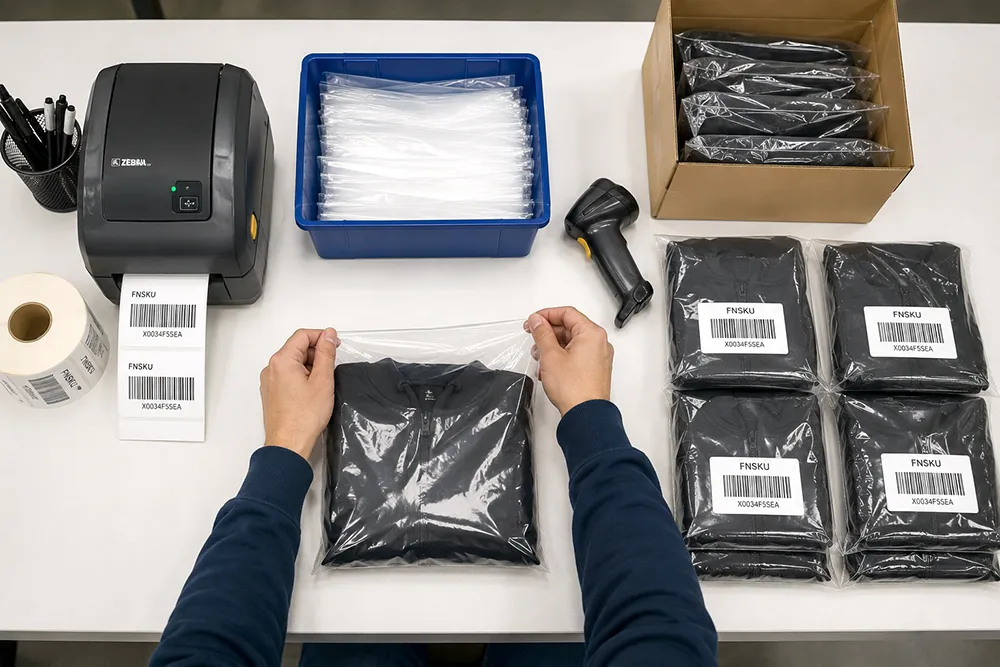
Every unit shipped to Amazon under FBA must have a scannable FNSKU barcode, Amazon’s internal tracking code that ties the unit to your specific seller account and listing.
FNSKU labels must be placed correctly: covering the manufacturer’s barcode (or in a specific location if the product has no existing barcode), printed at the correct size, and scannable without obstruction. Amazon specifies exact placement requirements by product category.
A prep center prints FNSKU labels and applies them to each unit. At Phoenix Warehouse, this is done by trained staff who know Amazon’s placement requirements across product categories, not a general warehouse worker applying labels wherever they fit.
Poly Bagging
Soft goods, multi-piece sets, products with loose components, and certain category items require poly bagging before they go to Amazon. Amazon specifies minimum bag thickness (typically 1.5 mil), a suffocation warning label on any bag with an opening larger than 5 inches, the bag must be sealed, and the FNSKU label must be visible through the bag or applied to the outside.
Poly bagging is one of the most common FBA prep failures for sellers doing their own prep: wrong gauge bag, missing suffocation warning, or label placement that’s not scannable.
Bubble Wrapping and Fragile Protection
Products in fragile categories (glass, ceramics, electronics, certain home goods) must have additional protective packaging before reaching Amazon. Amazon’s guidelines specify how fragile items must be wrapped and what drop-test standards the packaging needs to meet.
Phoenix Warehouse handles fragile prep for multiple product categories as part of standard FBA prep operations.
Bundling and Multi-Packs
If you’re selling a bundle (multiple different items sold as one ASIN) or a multi-pack (multiple units of the same item), the items must be packaged together as a single unit and labeled as such before they reach Amazon. Amazon does not assemble bundles at their fulfillment centers. It must arrive pre-assembled.
Bundle prep: confirming correct item counts, assembling the bundle, applying a single FNSKU label to the complete unit, and bagging or boxing as required.
Master Carton Labeling and Shipment Creation
When you ship to Amazon FBA, you create a shipment in Seller Central and Amazon assigns you a destination fulfillment center. Each master carton going to Amazon needs Amazon’s specific shipment ID label: a 4×6 label in a specific format with the shipment ID, box number, and destination.
Phoenix Warehouse handles shipment creation and carton labeling for FBA shipments as standard. Clients don’t need to manage the Seller Central shipment setup themselves unless they prefer to.
Quality Control Inspection
Before any inventory goes to Amazon, it’s worth knowing what you’re actually sending. A QC inspection at the prep stage catches units damaged in transit from the manufacturer, wrong items in a carton, count discrepancies, and products that don’t match the listing.
Catching these issues at the prep stage is far cheaper than dealing with them after Amazon receives the inventory. Amazon removals cost money, and stranded inventory affects your IPI score.
Phoenix Warehouse offers QC inspection as part of FBA prep. Items are checked against client specifications before they’re labeled and shipped to Amazon.
What Does FBA Prep Cost?
Prep costs vary by service, volume, and product complexity. Here are industry ranges. Actual rates depend on your specific product and volume:
| Service | Typical Range Per Unit |
|---|---|
| FNSKU labeling | $0.10 – $0.25 |
| Poly bagging | $0.20 – $0.50 |
| Bubble wrapping | $0.25 – $0.75 |
| Bundle / multi-pack assembly | $0.50 – $2.00 |
| QC inspection | $0.10 – $0.25 |
| Carton labeling + shipment creation | Often included or flat fee per shipment |
At higher volumes, per-unit costs typically come down. A seller shipping 5,000 units per month pays a different rate than one shipping 500.
Phoenix Warehouse provides custom FBA prep quotes based on your actual product, prep requirements, and volume. Share your product details and monthly volume and we’ll put together a full quote.
Why New Jersey Is the Right Location for FBA Prep
Location matters more for FBA prep than most sellers think, especially if you’re importing goods from overseas.
Port Newark is the busiest container port on the East Coast. If your goods come in by ocean freight from China, Southeast Asia, or Europe, there’s a good chance they’re arriving at Port Newark-Elizabeth. A prep center minutes from the port means your container can go straight from port to prep without a long drayage leg.
Phoenix Warehouse is located at 201 Port Jersey Blvd in Jersey City, NJ, one of the closest 3PL and FBA prep facilities to Port Newark. The distance from port to our dock is measured in minutes, not hours. That cuts drayage cost and turnaround time compared to a prep center further inland.
Amazon has multiple fulfillment centers in the tri-state area. Amazon FCs in New Jersey and the surrounding region include locations in Carteret, Robbinsville, and other nearby areas. Shipping from a prep center in Jersey City to nearby Amazon FCs is short-haul, which keeps outbound freight costs down.
Same-day or next-day turnaround is realistic. When your goods arrive from port in the morning, Phoenix can have them prepped and labeled by end of day, or the following morning for larger shipments. That speed matters when you’re managing reorder cycles and trying to stay in stock on Amazon.
How to Find a Reliable FBA Prep Center
Not all prep centers are equal. Here’s what to look for:
Amazon experience. Ask how many Amazon seller accounts they currently service and what product categories they handle regularly. A prep center that primarily does B2B logistics and “also does FBA” is different from one where FBA prep is a core operation.
Turnaround time commitment. Can they commit to 24-48 hour turnaround on your volume? Get this in writing.
Shipment creation capability. Do they create the FBA shipment in Seller Central, or do you have to do it and send them the plan? Either works, but know what you’re getting.
Rejection handling. If Amazon rejects a shipment due to prep issues, who fixes it and who pays? A confident prep center stands behind their work. At Phoenix Warehouse, if a rejection is caused by a prep error on our end, we fix and reship at no additional charge.
Real-time inventory visibility. You need to know when your goods arrive, how many units have been prepped, and when the shipment goes out. Phoenix Warehouse clients track this through Synapse WMS, with live visibility at every stage.
Combined fulfillment capability. The most efficient setup for many sellers is a prep center that also handles non-Amazon fulfillment (your website orders, wholesale orders, or other channels) from the same inventory pool. Phoenix Warehouse does exactly this: FBA prep and direct ecommerce fulfillment from the same facility, managed under one account.
Frequently Asked Questions
Can I use a 3PL for both FBA prep and regular ecommerce fulfillment?
Yes, and it’s often the most efficient setup. You store inventory at the 3PL, they prep and send units to Amazon FBA as needed, and they fulfill direct-to-consumer and wholesale orders from the same stock. Phoenix Warehouse handles all three from our Jersey City, NJ facility.
What happens if Amazon rejects a shipment?
Amazon will either return the shipment to you or dispose of it, both at your cost. A reliable prep center minimizes rejections by following Amazon’s prep guidelines exactly. At Phoenix Warehouse, if a rejection is caused by a prep error on our end, we fix and reship at no additional charge.
Can I split inventory between FBA and my own website from the same prep center?
Yes. This is one of the main advantages of using a 3PL as your prep center. Phoenix Warehouse holds your inventory, sends a portion to Amazon FBA as needed, and fulfills your Shopify, WooCommerce, or wholesale orders from the same pool, all tracked in real time through Synapse WMS. You decide the split; we execute it.
Does Phoenix Warehouse handle FBA prep?
Yes. Phoenix Warehouse offers FNSKU labeling, poly bagging, bubble wrapping, bundle assembly, QC inspection, and shipment creation at our 1,000,000 sq ft facility at 201 Port Jersey Blvd, Jersey City, NJ, minutes from Port Newark.
Do I need a separate prep center if I already have a 3PL?
Not necessarily. If your 3PL offers FBA prep, you can consolidate everything under one roof: one receiving process, one inventory system, one point of contact. That’s simpler and usually cheaper than splitting between two providers.
How far in advance do I need to send my inventory for FBA prep?
For standard FNSKU labeling and poly bagging, Phoenix Warehouse typically turns around shipments within 24-48 hours of receiving. Larger or more complex prep jobs may take longer. Discuss lead times when you get a quote.
Can Phoenix Warehouse receive containers directly from port?
Yes. Our location near Port Newark means we can receive containers via drayage directly from the port. We unload, inspect, prep, and ship to Amazon from the same facility.
What’s the minimum volume for FBA prep at Phoenix Warehouse?
We work with sellers at various volume levels. Contact us with your monthly unit volume and product details and we’ll let you know if it’s a good fit and what the economics look like.
Ready to Set Up FBA Prep Near Port Newark?
Phoenix Warehouse handles Amazon FBA prep (FNSKU labeling, poly bagging, bundling, QC inspection, and shipment creation) from our 1,000,000 sq ft facility in Jersey City, NJ. We’re minutes from Port Newark, which means your containers go straight from port to prep to Amazon with minimal handling and cost.
We’ve been running 3PL and fulfillment operations since 1997 and currently serve over 450 businesses across ecommerce, retail, manufacturing, and import distribution. FBA prep is part of a full-service operation, not a side offering.
Get an FBA prep quote from Phoenix Warehouse and share your product details and monthly volume. We’ll put together a custom rate.
Also in this series: