
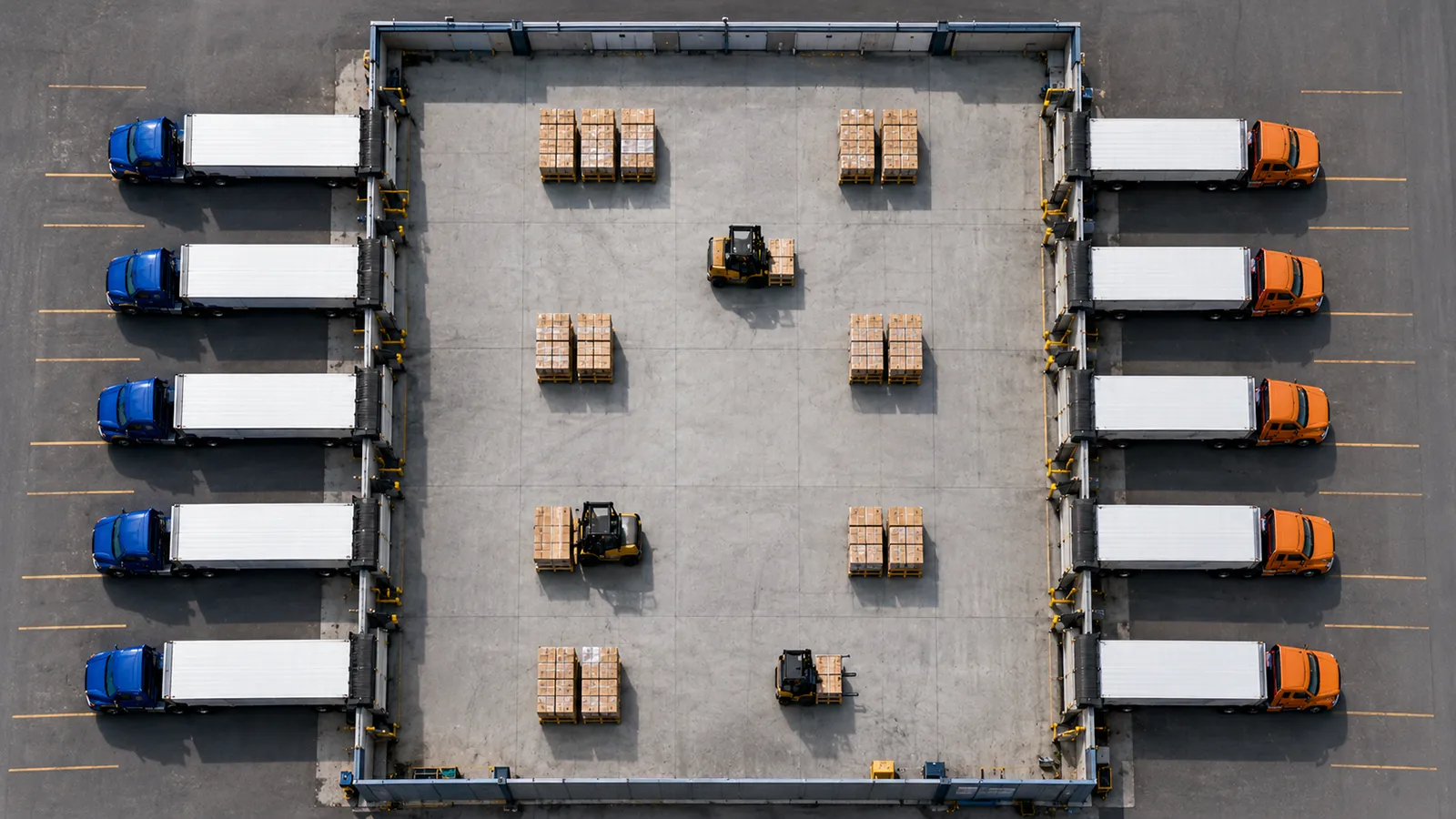

Cross-docking is a logistics process where goods arriving on inbound trucks or containers are transferred directly to outbound trucks with little to no time spent in storage. Instead of receiving goods, putting them away in a warehouse, and picking them back out later, cross-docking moves product from receiving dock to shipping dock, sometimes within hours of arrival.
It sounds simple, but it requires precise coordination. Inbound and outbound shipments have to align in timing, quantity, and destination. When it works, cross-docking cuts storage costs, reduces handling, and speeds up delivery. When the coordination breaks down, it creates expensive bottlenecks.
This guide covers exactly how cross-docking works, who benefits from it, how it compares to traditional warehousing, and when it makes sense to use it, including what to look for in a cross-dock facility near Port Newark.
How Cross-Docking Works: Step by Step
Cross-docking works by treating the warehouse as a transfer point rather than a storage location. The goal is to move goods through as quickly as possible: receive from one carrier, sort if needed, load directly onto outbound transport.
Here’s how a typical cross-dock operation runs:
Step 1: Inbound Shipment Arrives
A truck or container arrives at the cross-dock facility loaded with product. This could be a full truckload from a manufacturer, a container from port, or a consolidated shipment from a freight forwarder.
The inbound shipment is checked against advance shipping notices (ASNs), electronic documents that tell the facility what’s coming, how much, and where it needs to go. Good cross-docking runs on information received before the truck arrives, not after.
Step 2: Goods Are Unloaded and Sorted
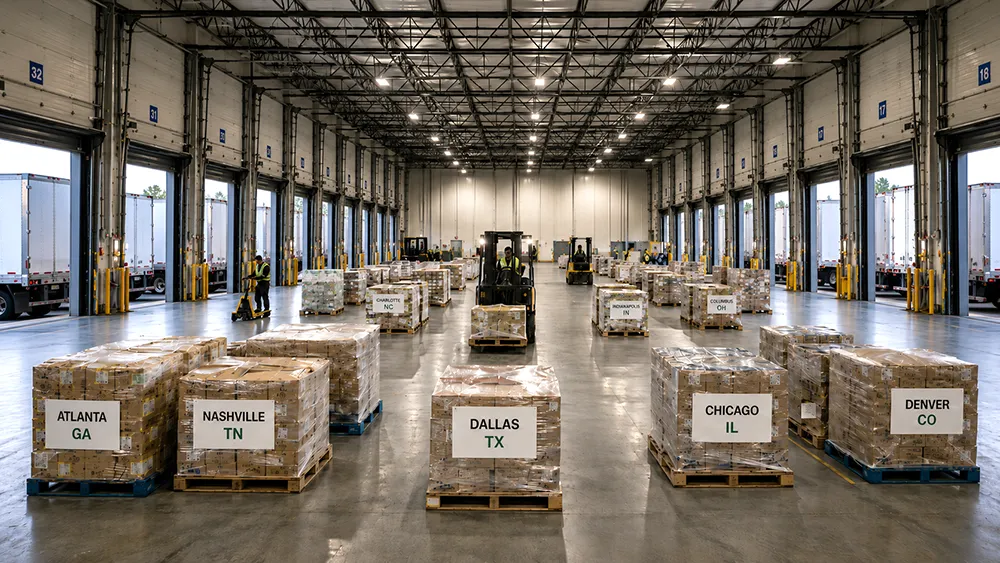
Product is unloaded at the receiving dock and moved to a staging area, a flat floor between inbound and outbound docks, not racking or shelving. At this stage, goods may be sorted by destination, by retail store, by customer order, or by outbound route.
Some cross-docking operations involve zero sorting. A full pallet arrives and goes directly to an outbound truck headed to the same destination. Others involve breaking down pallets and re-consolidating by destination, which takes more time but allows mixed-SKU inbound shipments to be properly distributed.
Step 3: Goods Are Loaded onto Outbound Transport
Sorted product moves directly from the staging area to outbound docks, where trucks are already lined up and waiting. In a pure cross-dock operation, goods spend hours in the facility, not days or weeks. The outbound trucks then carry goods to their final destinations: retail stores, distribution centers, Amazon fulfillment centers, or direct to customers.
Types of Cross-Docking
Not all cross-docking works the same way. The type depends on how much sorting and consolidation is needed:
Pre-distribution cross-docking: Suppliers pre-label and sort goods before they arrive. The cross-dock facility simply transfers them to outbound trucks. Minimal handling, maximum speed. This works when suppliers know the end destination of every pallet before shipping.
Post-distribution cross-docking: Goods arrive unsorted. The cross-dock facility determines routing and sorts product before loading outbound trucks. More flexible, but requires more labor and information systems.
Opportunistic cross-docking: Not a planned operation. Product that was destined for warehousing is redirected to direct outbound delivery because a matching order exists. Requires a warehouse management system capable of identifying these opportunities in real time.
Retail cross-docking: A retail distribution model where product from multiple suppliers arrives at a cross-dock and is consolidated by store. Each outbound truck carries a mixed load destined for a specific retail location. Walmart pioneered this model; most major retailers use some version of it.
Manufacturing cross-docking: Components arrive from multiple suppliers and are consolidated at a cross-dock for just-in-time delivery to a manufacturing plant, reducing on-site inventory at the plant.
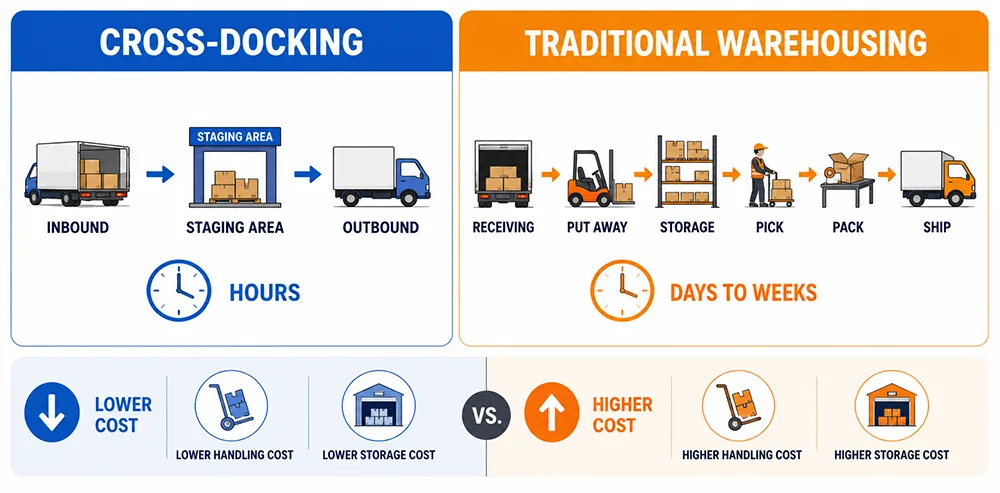
Cross-Docking vs. Traditional Warehousing
Cross-docking and traditional warehousing serve different purposes. One is built for speed and flow, the other for storage and flexibility. Most supply chains need both at different points.
| Factor | Cross-Docking | Traditional Warehousing |
|---|---|---|
| Storage time | Hours or less | Days, weeks, or months |
| Handling touches | Minimal (receive, sort, ship) | Multiple (receive, put away, pick, pack, ship) |
| Cost model | Lower storage cost, higher coordination cost | Higher storage cost, more predictable |
| Best for | High-velocity, predictable goods | Variable demand, safety stock, slow movers |
| Requires | Tight timing, advanced data, aligned carriers | Flexible scheduling, racking, picking systems |
| Inventory visibility | Real-time critical | Standard WMS sufficient |
| Who uses it | Retailers, grocery, manufacturers | E-commerce, importers, distributors |
The key question is whether your goods have a known destination when they arrive. If a pallet of product arrives and you already know exactly where it’s going and when it needs to be there, cross-docking makes sense. If product needs to be held until orders come in, or if demand is unpredictable, traditional warehousing is the right model.
Most businesses with complex supply chains use both: cross-docking for fast-moving, pre-sold product and warehousing for everything else.
Who Benefits Most from Cross-Docking?
Cross-docking delivers the biggest advantage to businesses where the cost of storage or the speed of delivery is a competitive factor, and where volumes are large enough to justify the coordination overhead.
Retailers with Multiple Store Locations
Large retailers receive consolidated shipments from suppliers at a cross-dock, sort by store, and load outbound trucks for each location. Instead of running separate deliveries from each supplier to each store, the cross-dock acts as a hub. Goods move through faster, and stores get mixed-product deliveries from a single truck rather than multiple supplier runs.
Perishable Goods and Food Distribution
Refrigerated and perishable product can’t sit in a warehouse waiting to be picked. Cross-docking keeps dwell time to a minimum. Product arrives cold and goes out cold, minimizing the time between producer and retailer.
Importers with Predictable Distribution
If you import product from overseas and already know which distribution centers or retail partners are getting what, cross-docking at a port-proximate facility makes economic sense. Product arrives from port, gets sorted by destination, and loads onto outbound trucks. One smooth move, no put-away or pick costs.
E-Commerce with Pre-Sold Inventory
Businesses that sell before they receive (taking orders while goods are in transit) can use cross-docking to ship pre-sold inventory directly on arrival without ever putting it on a shelf. This is especially useful for flash sales, pre-orders, or subscription boxes where the order list is known in advance.
Manufacturing JIT Operations
Manufacturers that run lean inventory models use cross-docking to receive components from multiple suppliers and consolidate them for just-in-time delivery to the production line. Zero buffer stock at the plant means cross-docking reliability is critical. A missed delivery stops production.
When Cross-Docking Doesn’t Make Sense
Cross-docking isn’t right for every situation. It fails when:
Demand is unpredictable. If you don’t know where product is going when it arrives, you can’t cross-dock efficiently. You need the flexibility of warehouse storage to hold product until orders come in.
Volumes are too low. The coordination cost of running a cross-dock operation (advanced shipping notices, synchronized carrier schedules, real-time WMS data) isn’t worth it for small shipment volumes. Traditional warehousing is simpler and often cheaper below a certain threshold.
Inbound and outbound timing doesn’t align. Cross-docking requires inbound and outbound trucks to be synchronized. If your inbound arrives Tuesday but your outbound carriers don’t pick up until Friday, you’re effectively warehousing.
Product requires inspection or value-added work. If goods need quality inspection, re-labeling, kitting, or other processing before they go out, they can’t move through a pure cross-dock. They need to stop in a facility where that work gets done. That’s warehousing, not cross-docking.
You’re running Amazon FBA. Amazon has specific prep requirements (FNSKU labeling, poly bagging, bundling) that must be completed before goods reach an Amazon FC. That prep work requires dwell time in a facility and isn’t compatible with a pure cross-dock model. FBA prep at a 3PL like Phoenix Warehouse, followed by outbound to Amazon, is the right workflow.
Cross-Docking and Transloading: What’s the Difference?
These two terms often get confused because they both involve moving goods between transport modes at an intermediate facility.
Cross-docking keeps goods in the same packaging and transfers them from inbound to outbound transport, sorted by destination. The product itself isn’t changed.
Transloading involves moving goods from one type of transport unit to another, typically from an ocean shipping container into standard domestic trailers (ocean containers can’t run on domestic highways without special weight permits). Product is unloaded from the container and reloaded into 53ft dry van trailers for distribution.
Both happen at port-proximate facilities, and both are done to speed up distribution. Phoenix Warehouse at 201 Port Jersey Blvd handles both: container receipt from Port Newark drayage, transloading into domestic trailers, and cross-dock distribution across the Northeast.
What to Look for in a Cross-Dock Facility
The facility: A true cross-dock is built for flow: wide staging floors, dock doors on both sides of the building, minimal racking. If a facility has to thread cross-dock product through a traditional pick-and-pack warehouse, it’s not optimized for it.
Advanced shipping notice capability: Cross-docking without ASNs is chaotic. Your facility needs to receive electronic notification of inbound shipments before the truck arrives: product type, quantity, destination, timing. Without this, sorting decisions get made on the fly, which costs time and creates errors.
Carrier relationships: Outbound carriers need to be lined up when inbound product arrives. A cross-dock facility with strong carrier relationships and established outbound routes handles this better than one that’s booking trucks on a spot basis.
WMS integration: Your warehouse management system needs to track product in real time from inbound dock to outbound dock. Scan-to-confirm receiving, real-time inventory (even if goods are only in the facility for hours), and automated outbound confirmation are standard expectations.
Port proximity: For importers using cross-docking to move goods off containers quickly, proximity to Port Newark is a meaningful advantage. Short drayage moves reduce detention risk, cut cost, and compress the time between container arrival and product distribution.
Phoenix Warehouse is located at 201 Port Jersey Blvd in Jersey City, NJ, minutes from Port Newark. Our 1,000,000 sq ft facility handles cross-docking alongside traditional 3PL warehousing, bonded storage, and fulfillment. Most clients use a combination: cross-docking for fast-moving, pre-sold product, and warehousing for everything else.
Frequently Asked Questions
What is cross-docking in simple terms?
Cross-docking is when goods arrive at a warehouse, get sorted quickly, and go straight back out on trucks to their next destination, with little or no time stored on shelves. The warehouse acts as a transfer point, not a storage location.
What is the main advantage of cross-docking?
Speed and lower handling cost. Product moves through the supply chain faster because it’s not sitting in storage waiting to be picked. There’s also less handling. Fewer touches between manufacturer and end customer means lower labor cost and less damage risk.
Does cross-docking work for ecommerce?
It can work for specific use cases: pre-sold inventory, subscription boxes, or flash sale fulfillment where the order list is known before product arrives. For standard ecommerce where orders come in unpredictably, traditional pick-pack-ship fulfillment is more appropriate. Most ecommerce 3PLs use a hybrid.
What’s the difference between cross-docking and drop shipping?
Drop shipping is a fulfillment model where a supplier ships directly to the customer, bypassing the retailer’s warehouse entirely. Cross-docking is a warehouse operation where product still moves through a facility, just very quickly. They solve different problems.
How much does cross-docking cost?
Pricing depends on volume, complexity, and whether sorting or labeling is involved. Cross-docking typically costs less than full warehousing per unit because you’re not paying for put-away or pick labor. But it requires coordination overhead that adds cost elsewhere. Contact Phoenix Warehouse for a quote based on your specific shipment volumes and routing requirements.
Does Phoenix Warehouse offer cross-docking?
Yes. Phoenix Warehouse handles cross-docking at our 1,000,000 sq ft facility in Jersey City, NJ, including container receipt via Port Newark drayage, sort and stage operations, and outbound carrier loading, alongside traditional warehousing, bonded storage, and fulfillment for clients who need both.
Can cross-docking work with Amazon FBA?
Partially. The cross-dock model can work for the inbound leg, moving product from port to prep facility quickly. But Amazon FBA prep (FNSKU labeling, poly bagging, etc.) requires dwell time at a facility. You need a 3PL that handles both: fast receipt and cross-dock movement for some product, and FBA prep operations for what’s going to Amazon.
Need Cross-Docking Near Port Newark?
Phoenix Warehouse handles cross-docking, transloading, and traditional 3PL warehousing from our 1,000,000 sq ft facility at 201 Port Jersey Blvd, Jersey City, NJ, minutes from Port Newark-Elizabeth Marine Terminal.
We’ve been running logistics operations since 1997 and serve over 450 businesses across retail distribution, import, ecommerce, and manufacturing. Our facility is CBP bonded, FDA registered, USDA compliant, and NYNJ rail-accessible, which means product moving through our cross-dock has access to every distribution option in the Northeast from one location.
Get a quote from Phoenix Warehouse and let’s talk through whether cross-docking, traditional warehousing, or a combination is the right setup for your supply chain.
Also in this series:
- What Is a 3PL? How Third-Party Logistics Works and When You Need One
- What Is a Bonded Warehouse? How It Works and Why Importers Use One
- How to Choose an Ecommerce Fulfillment Service
- Amazon FBA Prep: What It Is, What It Costs, and Why NJ Is the Right Location
- What Is Drayage? Port-to-Warehouse Trucking Explained