
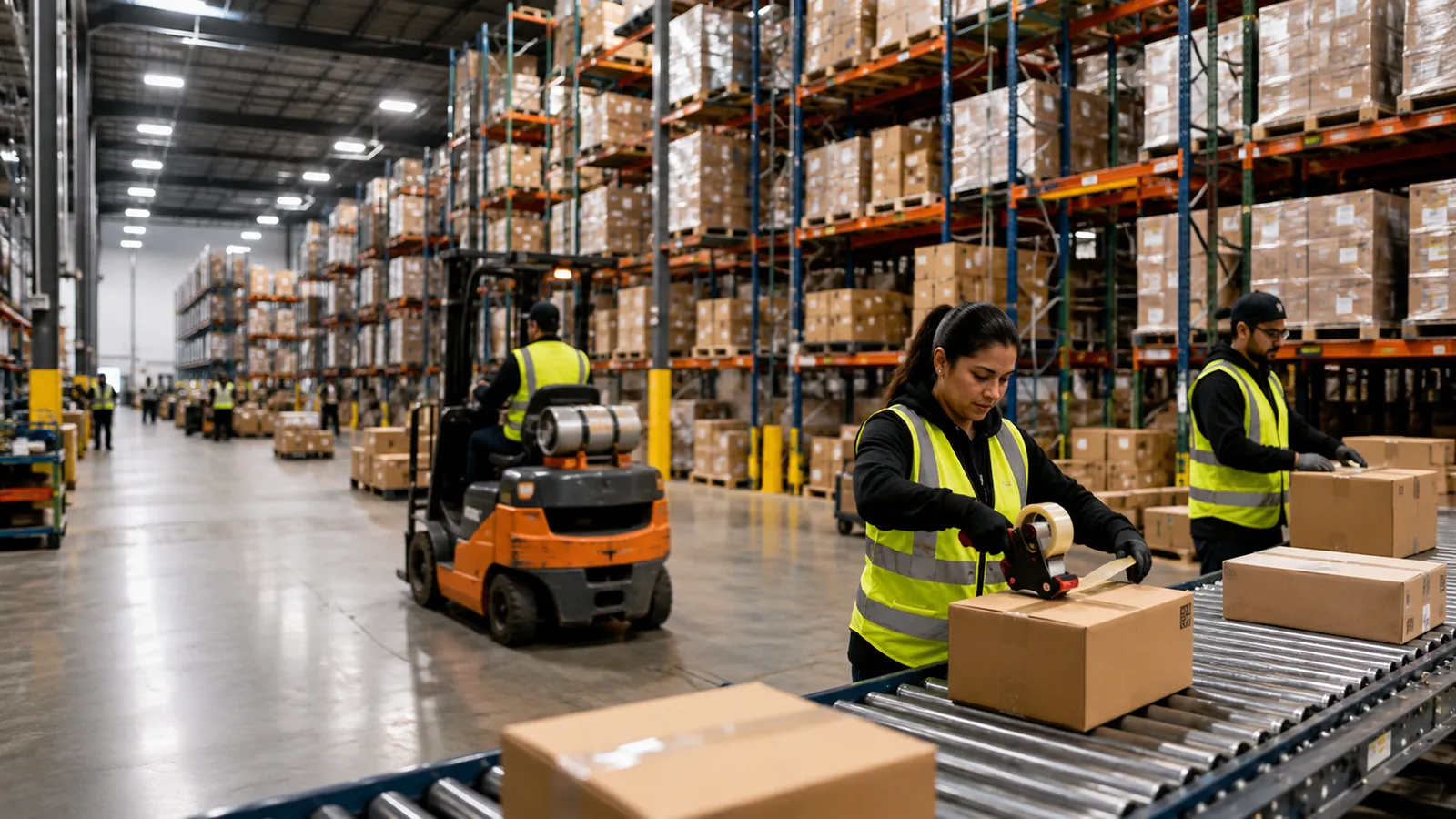

A 3PL, or third-party logistics provider, is a company that manages warehousing, order fulfillment, and transportation on behalf of another business. You outsource the physical supply chain; they run the day-to-day operations.
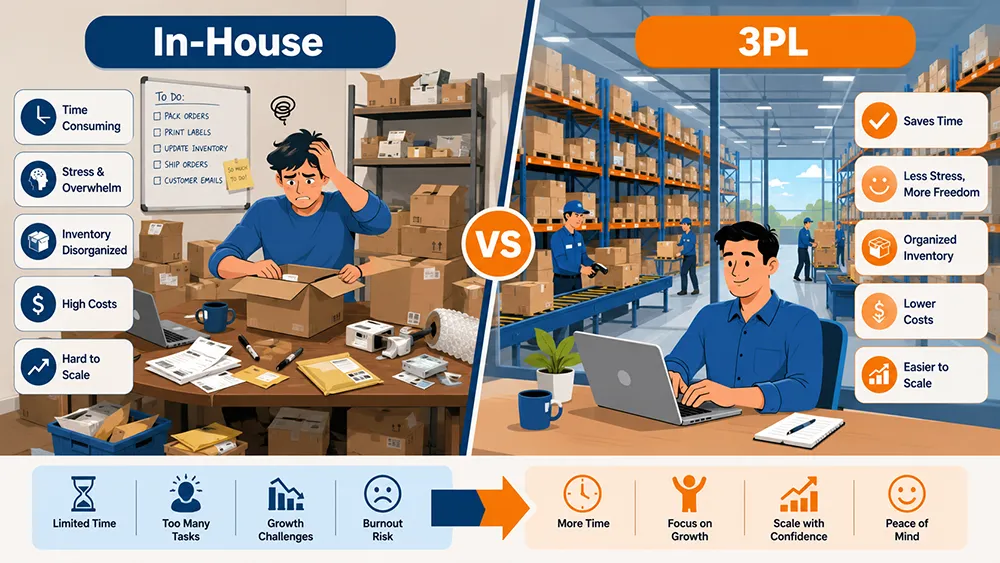
If you’re spending more time packing boxes and booking freight than actually running your business, it might be time to hand that off. That’s exactly what a 3PL is for.
Third-party warehousing companies store your inventory, pick and pack your orders, and ship them out. You focus on selling; they handle the operations behind it.
But 3PLs aren’t all built the same, and choosing the wrong one at the wrong time can cost more than doing it yourself. Here’s a plain-English breakdown of how it all works, including what to look for if you’re sourcing a third party warehousing company in New Jersey or the broader tri-state area.
What Does 3PL Stand For?
3PL stands for third-party logistics. The “third party” distinction matters: it means you’re working with an outside company, not your own staff or facility. You own the inventory; they own or lease the building, equipment, and workforce that moves it.
Some 3PLs do everything under one roof: receiving, storage, fulfillment, freight, and value-added services like kitting or repackaging. Others specialize in one piece, fulfillment only or freight only. Full-service 3PLs are generally easier to work with because you have one point of contact instead of juggling multiple vendors.
Phoenix Warehouse, based in Jersey City, NJ, has operated as a full-service 3PL since 1997, handling warehousing, fulfillment, transportation, and value-added services for over 450 businesses from a single 1,000,000 sq ft facility near Port Newark.
What Does a 3PL Actually Do?
Warehousing and Storage
Your inventory lives at the 3PL’s facility. You pay for the space you use. No building lease, no racking to buy, no warehouse staff to hire or manage. When your inventory levels change, your costs adjust with them.
Most 3PLs charge per pallet per month for storage. Some use a bin or cubic foot model for smaller SKUs. Either way, you’re only paying for what you’re actually using.
Phoenix Warehouse operates 1,000,000 sq ft of warehouse space in Jersey City, NJ, making it one of the largest independent 3PL facilities in the New York/New Jersey metro area. The location puts clients within one-day ground shipping reach of over 50 million people across the Northeast.
Order Fulfillment
Order fulfillment at a 3PL means the provider picks, packs, and ships customer orders on your behalf, automatically connected to your sales platform. When a customer orders on Shopify, WooCommerce, or Amazon, the order flows directly into the 3PL’s warehouse management system and gets processed without manual entry.
A well-run 3PL processes orders the same day they come in. At Phoenix Warehouse, same-day shipping cutoffs are mid-afternoon for most clients, and the facility maintains a 99.96% order accuracy rate across all channels.
Transportation and Freight
Many 3PLs have negotiated carrier accounts with UPS, FedEx, and USPS. These volume rates get passed through to clients and are typically lower than what a business would get on its own.
Phoenix Warehouse goes further: through All City Leasing and Warehousing, Phoenix operates its own fleet of 100 trucks covering local, regional, and national delivery. For international freight (ocean, air, and rail), Phoenix works with established carrier partners to move shipments across borders. Having an in-house fleet is a meaningful advantage for businesses that need reliable last-mile delivery in the New Jersey and New York metro area without depending on third-party carriers.
Value-Added Services
Beyond storage and shipping, full-service 3PLs offer work that goes deeper into your supply chain. Kitting (assembling multiple items into one sellable set), repackaging, labeling, quality control inspections, and returns processing all fall under value-added services.
Not every 3PL offers these. Some are strictly pick-pack-ship. If you need anything beyond basic fulfillment, confirm it’s available before you commit. Phoenix Warehouse offers a full range of value-added services at its Jersey City facility, which means clients don’t need a separate vendor for assembly, kitting, or returns.
3PL vs. In-House Fulfillment: When Does It Make Sense to Switch?
The tipping point for switching to a 3PL is usually when the cost and time of running fulfillment yourself exceeds what an outside provider would charge.
In-house fulfillment makes sense when:
- You’re shipping fewer than 50-100 orders per day
- Your packaging is highly custom and requires hands-on oversight a 3PL can’t replicate at scale
- You’re just starting out and don’t have consistent enough volume to hit a 3PL minimum
A 3PL makes sense when:
- You’re shipping 100+ orders per day and fulfillment is consuming staff hours that should go elsewhere
- You sell on multiple channels (your website, Amazon, wholesale) and need a central hub
- You’re getting hit hard during peak season because you don’t have the space or staff to scale
- Your warehouse lease is coming up and you’d rather not sign another one
- You want to reach more customers faster without opening a second location
A common threshold: once fulfillment is taking 20+ hours of staff time per week, or you missed shipments during your last peak season, it’s worth getting a 3PL quote and running the actual numbers.
Types of 3PL Providers
Not all third party warehousing companies operate the same way. Here’s how they break down:
Asset-based 3PLs own their own warehouses and trucks. You’re working directly with the facility and the fleet, with no brokers or middlemen between you and the people handling your inventory. Phoenix Warehouse is asset-based: the company owns its 1,000,000 sq ft New Jersey facility and operates its own transportation fleet through All City Leasing and Warehousing.
Non-asset 3PLs broker capacity through a network of partner warehouses and carriers. They can offer geographic flexibility, but you’re often one step removed from the people actually handling your goods.
Fulfillment-only 3PLs focus exclusively on pick-pack-ship. They’re often well-integrated with e-commerce platforms but won’t help you with inbound freight management, bonded storage, or retail distribution.
Full-service 3PLs handle everything: receiving, storage, fulfillment, freight, returns, and value-added services. One facility, one team, one invoice. This works best for businesses with complex supply chains or multiple sales channels.
Freight forwarders specialize in international shipping, moving goods across borders by ocean, air, or rail. They’re generally not set up for domestic fulfillment, so they’re usually a separate relationship from your 3PL.
What Does a 3PL Cost?
3PL pricing has more line items than most people expect. Here’s what you’ll typically see:
| Fee Type | What It Covers | Typical Range |
|---|---|---|
| Receiving | Unloading, counting, check-in when inventory arrives | $8-$15 per pallet or $25-$45/hr |
| Storage | Space used per month | $10-$25 per pallet/month |
| Pick fee | Base fee per order processed | $1.50-$3.00 per order |
| Pack fee | Per additional item beyond first in the order | $0.20-$0.50 per item |
| Packaging materials | Boxes, poly mailers, tape, inserts | $0.50-$3.00 per order |
| Outbound shipping | Carrier charge at 3PL’s volume rate | Varies by carrier/zone |
| Returns processing | Receive, inspect, restock or disposition | $2-$5 per unit |
| Account minimum | Monthly floor regardless of volume | $500-$2,000/month |
The total varies based on volume, SKU count, order size, and packaging requirements. Phoenix Warehouse provides custom quotes based on your actual order profile. The math is different for every business, so a real quote is the only way to know if the numbers work.
How to Choose the Right 3PL
Five things that matter most when evaluating third party warehousing companies:
Order accuracy rate. Ask for documented data. The industry benchmark is 99.5%+. Phoenix Warehouse runs at 99.96%, confirmed across all client accounts. If a 3PL can’t give you a specific, verified number, that’s a problem.
System integrations. Your 3PL needs to connect directly to wherever you sell: Shopify, Amazon, WooCommerce, EDI-connected retailers. Ask how integration works, how long setup takes, and whether there are per-channel fees. Phoenix integrates with all major e-commerce platforms through Synapse WMS, typically within two weeks of onboarding.
Location relative to your customers and your port. A warehouse in New Jersey, specifically near Port Newark, gives you one of the best logistics positions on the East Coast. One-day ground delivery covers the entire Northeast, and same-day drayage from port is possible when your 3PL is minutes away.
Pricing transparency. Ask for a full fee schedule upfront, including receiving, storage, pick fees, pack fees, returns, and any peak season surcharges. Hidden fees around special handling, minimum charges, and dimensional weight are common in this industry.
Scalability. Can this 3PL handle double your current volume? What’s their process for Q4 peaks? A 3PL that works well at your current size but can’t scale when you need them to is more of a risk than an asset.
For a deeper breakdown on choosing a fulfillment partner, read our guide on how to choose an ecommerce fulfillment service.
What Is a 4PL, and How Is It Different from a 3PL?
A 4PL (fourth-party logistics provider) manages your entire supply chain, including multiple 3PLs, acting as a single coordinator across all logistics operations. A 3PL handles physical logistics: warehousing, fulfillment, and transportation. A 4PL sits above that, managing multiple 3PLs and acting as a supply chain architect.
Here’s the practical difference:
A 3PL picks up your inventory, stores it, ships orders, and handles returns. You work with them directly. You see what’s happening in their facility.
A 4PL coordinates several 3PLs across different regions or functions, manages the relationships, optimizes the network, and reports up to you. You interact with the 4PL; the 4PLs deal with the 3PLs underneath.
When does a 4PL make sense? Generally when you’re running a large, multi-region operation: multiple warehouses across North America or globally, complex routing requirements, or a supply chain too large to manage with a single 3PL relationship. For most small and mid-sized businesses, a 4PL adds cost and management overhead that isn’t justified. A single, full-service 3PL like Phoenix Warehouse covers everything under one roof without the added layer.
If you’re evaluating whether you need a 3PL or a 4PL, the honest answer for most businesses is: start with a strong 3PL. You can always add coordination layers later if your supply chain genuinely requires it.
Frequently Asked Questions
What’s the difference between a 3PL and a warehouse?
A warehouse stores goods. A 3PL does that plus order fulfillment, transportation, and often value-added services. The distinction is the service model: a 3PL is an active operations partner, not just a place to store inventory.
How do I know if I’m ready for a 3PL?
A good indicator is when fulfillment is consuming more than 20 hours a week of staff time, or when you’ve missed shipments during a peak period. At that point the cost of staying in-house usually exceeds what a 3PL would charge.
Can a 3PL handle both retail and e-commerce orders?
Yes. Established 3PLs like Phoenix Warehouse handle both B2C e-commerce orders and B2B retail orders (store replenishment, EDI orders to chains like Target or Walmart) from the same New Jersey facility. This is called omnichannel fulfillment and it’s one of the main advantages of working with a full-service provider.
Does a 3PL work for small businesses?
It depends on volume. Most 3PLs have monthly minimums, so if you’re shipping fewer than 100-200 orders per month the economics may not work yet. It’s worth getting a quote to run the actual numbers for your situation.
How long does it take to set up with a new 3PL?
Typically 2-4 weeks for onboarding: system integration, inventory transfer, receiving, and configuration. Phoenix Warehouse targets 2 weeks for most new clients.
Where is Phoenix Warehouse located?
Phoenix Warehouse is located at 201 Port Jersey Blvd, Jersey City, NJ 07305, minutes from Port Newark-Elizabeth Marine Terminal, with NYNJ rail access and direct highway connections to I-78 and the New Jersey Turnpike.
Ready to Talk to a 3PL in New Jersey?
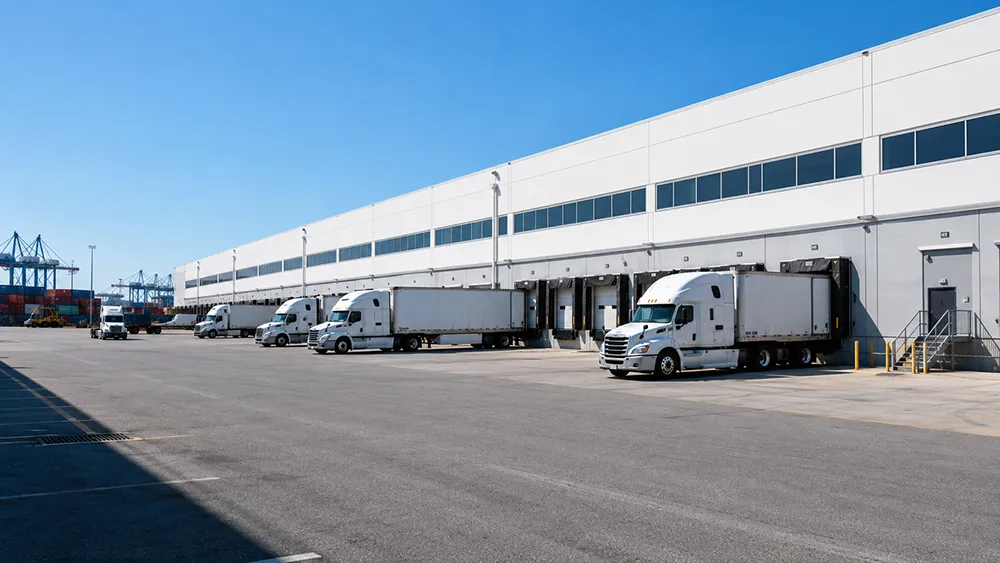
Phoenix Warehouse is a full-service 3PL in Jersey City, NJ. We offer warehousing, fulfillment, transportation, and value-added services under one roof since 1997. We work with over 450 businesses across e-commerce, retail, manufacturing, and distribution from our 1,000,000 sq ft facility near Port Newark.
Our facility is CBP bonded, FDA registered, USDA compliant, and NYNJ rail-accessible. Same-day shipping cutoffs, 99.96% accuracy, and a dedicated account team. No call centers, no runaround.
Get a quote from Phoenix Warehouse and we’ll put together a custom rate based on your actual volume and requirements.
Also in this series: